 EN
EN NL
NL DE
DE FR
FR
Fuel stations in Greece are generally reliable, well regulated, and easy to use, but in 2026 fuel prices, availability, and local conditions matter more than ever for visitors. This is especially true in Crete, where fuel prices are often higher than on the mainland, distances between towns are longer, and refuelling options can vary between busy north-coast cities, rural areas, and airport zones.
This guide explains how fuel stations work in Greece and what specifically applies in Crete in 2026, including fuel types used by rental cars, how fuel prices are displayed, where fuel stations are concentrated on the island, typical opening hours, and practical refuelling tips. It is written for tourists driving a rental car in Crete and covers key scenarios such as long rural drives and refuelling near Heraklion Airport and Chania Airport, helping you plan confidently and avoid last-minute issues.
Table of Contents
- How Fuel Stations Work in Greece and How This Applies in Crete
- Refuelling a Car Step by Step, with Crete-Specific Considerations
- Fuel Types in Greece: What Tourists Need to Know when Visiting Crete
- Fuel Prices in Crete in 2026
- Opening Hours of Fuel Stations in Crete
- How to Find a Fuel Station in Greece
- Fuel Types & Fuel Policy for Rental Cars in Crete
- Rent a Car in Crete with Motor-plan and start exploring the island independently
- FAQs About Fuel Stations in Crete
How Fuel Stations Work in Greece and How This Applies in Crete
Fuel stations in Greece operate under a national regulatory framework, and the basic refuelling process is the same throughout the country. Drivers mostly encounter full-service stations, while self-service is rare and depends on the station. Payment is usually made after refuelling, either at the cashier or directly to station staff.
In Crete, these same rules apply, but the way drivers experience them is shaped by the island’s layout, longer driving distances, and the concentration of services around specific towns and transport hubs such as Heraklion, Chania, Rethymno, and Agios Nikolaos.
Fuel stations are operated by a mix of independent owners and well-known fuel brands commonly found across Greece, including EKO, BP, Shell, AVIN, Aegean, and Revoil. These brands are widely present along the north coast, in major cities, and on main intercity routes. Fuel quality is regulated nationally, so while prices and availability vary by location, standards remain consistent regardless of brand.
In Heraklion and Chania, especially on main roads and near airport access routes, there are many petrol stations. In mountain villages and southern Crete, petrol stations may be fewer, smaller, and more likely to close earlier in the evening.
Tip: If an attendant approaches your your vehicle, it is normal to let them refuel the car. This is standard local practice and does not require tipping.
Refuelling a Car Step by Step, with Crete-Specific Considerations
To refuel a car in Greece, including in Crete:
- Pull up to a pump showing the correct fuel type (usually Unleaded 95 or Diesel)
- In many parts of Crete, an attendant may refuel the car—tell them the fuel type and either a specific amount (€) or “fill it up”
- Pay at the cashier or directly to the attendant, depending on the station
Fuel Types in Greece: What Tourists Need to Know when visiting Crete
Fuel types are clearly labelled at petrol stations, but names and abbreviations may differ from what visitors are used to. Knowing which fuel your rental car needs is essential to avoid costly mistakes.
1. Unleaded Petrol
Unleaded 95 (RON 95)
This is the most common fuel for rental cars in Crete.
- Labelled as Unleaded 95, 95, or Αμόλυβδη 95
- Widely available across the island
- Suitable for most petrol vehicles
Unleaded 98 or 100 (Premium Petrol)
- Available at some larger or branded stations.
- More expensive
- Not required unless specified by the rental company
- Does not improve performance in cars designed for Unleaded 95
2. Diesel
Diesel vehicles are very common in Crete, especially for longer or mountainous drives.
- Labelled as Diesel or Diesel Extra
- Widely available across the island
- Often more fuel-efficient
Important: Never confuse diesel with petrol. Misfuelling can cause serious engine damage and is not covered by rental insurance.
3. LPG and Other Fuels
- LPG (Autogas): Limited availability, mainly near larger towns; rarely used by rental cars
- CNG: Extremely rare and not relevant for tourists in Crete
Fuel Prices in Crete in 2026
Fuel prices in Crete fluctuate and vary by location, but they are often higher than on mainland Greece due to transportation and supply costs.
Typical Fuel Prices in 2026
- Unleaded 95 (RON 95): roughly €1.70–€1.85 per litre
- Diesel: roughly €1.45–€1.65 per litre
Other Fuel Prices in Crete (Indicative)
- Unleaded 98 or 100: often around €1.90–€2.10 per litre
- LPG (Autogas): roughly €0.95–€1.05 per litre, where available
Where Fuel Prices Tend to Be Higher
Fuel prices tend to be highest:
- Near airports and ports
- In popular tourist areas
- In remote or mountainous parts of the island
Tip: If it’s your first time renting a car in Crete, keep in mind that refuelling a short distance away from Heraklion Airport or Chania Airport can significantly reduce costs.
Opening Hours of Fuel Stations in Crete
| Location Type | Typical Hours | Important Info |
|---|---|---|
| Cities (Heraklion, Chania) | 06:00–07:00 to 21:00–23:00 | Longer hours in summer |
| Main roads / airport routes | Extended | Often busiest |
| Rural & mountain areas | Shorter | May close early or overnight |
Fuel station opening hours in Crete vary by location, traffic levels, and season. While the island follows the same general practices as mainland Greece, fewer late-night options and longer distances between towns make planning more important.
In cities such as Heraklion and Chania, many petrol stations operate from early morning (around 6:00–7:00 am) until late evening (9:00–11:00 pm). Stations on main roads, near busy junctions, and close to airport access routes often stay open longer, especially in summer.
In smaller towns, rural areas, mountain villages, and southern Crete, petrol stations may:
- Open later in the morning
- Close earlier in the evening
- Shut completely overnight
Outside peak summer months, reduced hours are more common.
How to Find a Fuel Station in Greece
Finding a fuel station in Greece is easiest when planned in advance, especially when driving outside major cities or on islands such as Crete.
- In large cities, traffic congestion and narrow streets can make last-minute detours difficult
- On highways and rural roads, fuel stations may be spaced far apart and signage can be limited
The most reliable ways to locate fuel stations are digital maps and apps:
-
Digital maps like Fuelgr
- Show fuel stations across Greece with current prices
- Allow filtering by fuel type
- Are available in English and practical for on-the-go use
-
Navigation apps
- Google Maps: search fuel station or petrol station
- Maps.me: useful for offline navigation in areas with limited mobile signal
Fuel station distribution is not uniform, particularly in Crete:
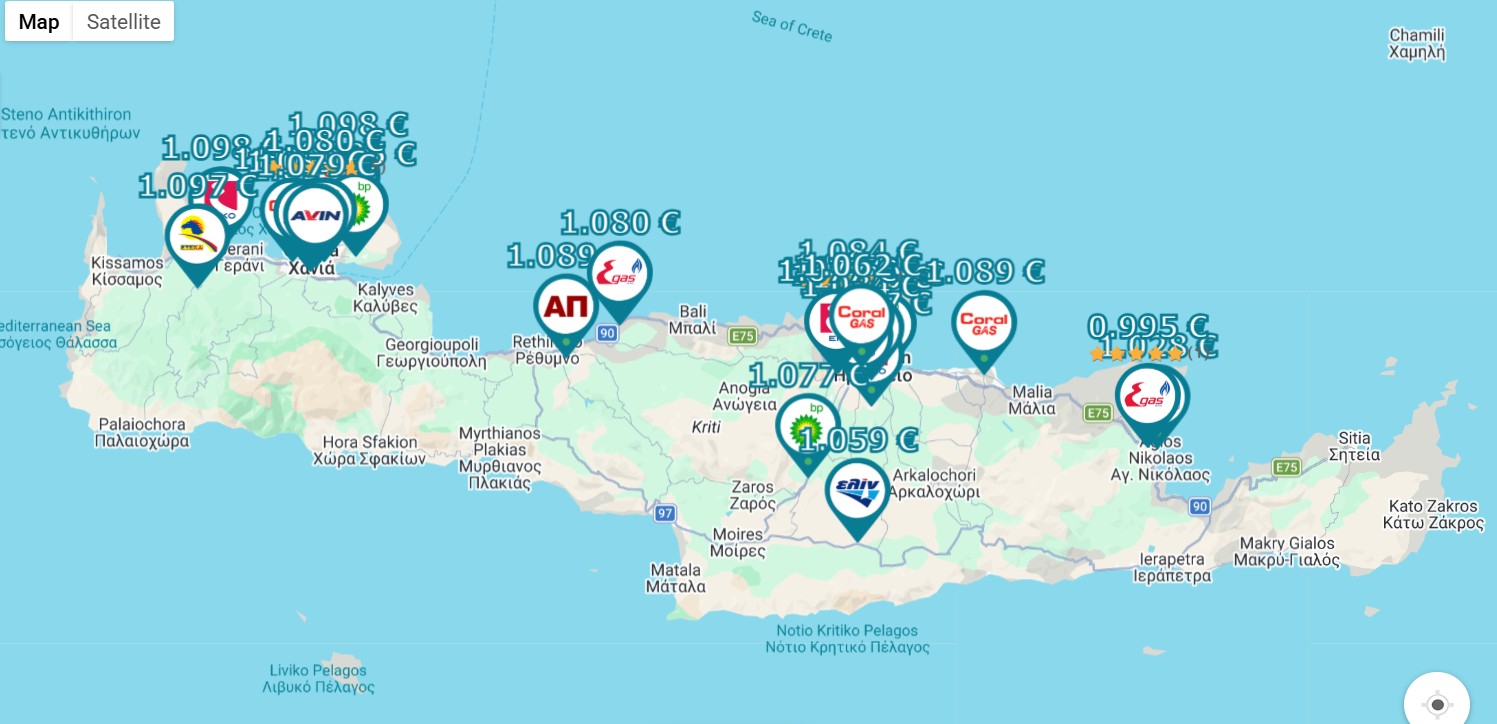
- The highest concentration is found along the north coast and around Chania, Rethymno, Heraklion, and Agios Nikolaos
- Fuel stations appear frequently along the main east–west routes
- Fuel stations become significantly fewer in southern Crete, inland areas, and mountain regions
- Distances between stations increase, and opening hours become more limited away from urban centres
For this reason:
- Refuel before long rural or mountain drives
- Avoid relying on late-night refuelling outside cities
- Plan fuel stops in advance for airport returns
- Do not wait until the fuel level is low to search for a station.
Fuel Types & Fuel Policy for Rental Cars in Crete
When renting a car in Crete, understanding fuel types and fuel responsibility is essential. Fuel is always paid by the customer, and the customer is responsible for refuelling the vehicle correctly during the rental period.
Most Common Fuel Types for Rental Cars
Most rental cars offered in Crete use one of the following fuel types:
- Unleaded 95 (RON 95) – standard fuel for most petrol vehicles
- Diesel – commonly used for larger cars or vehicles intended for longer distances
These fuels are widely available across the island. Alternative fuels such as LPG (Autogas) or CNG are generally not applicable to rental cars, unless explicitly stated in the rental agreement.
Fuel Responsibility and Return Condition
According to standard rental conditions:
- Fuel costs are not included in the rental price
- The customer pays for all fuel used
- The customer is obliged to return the car with the same level of fuel that was in the fuel tank at the time of pick-up
Important: If the vehicle is returned with a lower fuel level, additional refuelling charges may apply, as outlined in the rental terms. You can check the Motor-plan rental terms for more info.
Rent a Car in Crete with Motor-plan and Start Exploring the Island Independently
When driving a rental car in Crete, knowing how and where to refuel helps avoid unnecessary delays and extra charges. Fuel costs are the customer’s responsibility, and the vehicle must be returned with the same fuel level as collected. With your own car, you can choose fuel stations outside crowded areas, plan refuelling in advance, and travel more comfortably across the island. Rent a car in Crete with Motor-plan and explore Crete at your own pace, staying in control of your refuelling stops.
FAQs About Fuel Stations in Crete
How do petrol stations work in Crete?
Petrol stations in Crete follow the same rules as the rest of Greece. Most stations are attended (full-service) and payment is usually made after refuelling.
Are fuel stations in Crete open on Sundays and public holidays?
Many fuel stations in cities and on main roads remain open on Sundays and public holidays, especially in summer. In rural areas and smaller towns, some stations may close or operate reduced hours, so planning ahead is recommended.
Can I pay for fuel by card everywhere in Crete?
Card payments are widely accepted in cities, near airports, and at larger branded stations, but some small rural fuel stations may accept cash only. Carrying a small amount of cash is advisable when driving outside urban areas.
Do fuel prices change during the day in Crete?
Fuel prices in Crete typically change daily, not hourly. However, prices can vary noticeably between locations, especially near airports, ports, and tourist areas compared to inland or residential zones.
Are there enough fuel stations for long drives in Crete?
Fuel stations are widely available along the north coast and main roads, but less frequent in southern Crete, inland areas, and mountain regions. For long or rural drives, refuelling before leaving major towns is strongly recommended.
What happens if I return a rental car with less fuel?
If a rental car is returned with a lower fuel level than at pick-up, the rental company will usually charge for refuelling, often at a higher rate than local fuel prices. This is outlined in the rental terms.
Can I refuel late at night in Crete?
Late-night refuelling options are limited outside major cities. Some stations offer automated or prepaid pumps, but availability is not guaranteed. It’s best to refuel earlier in the day, especially before rural or early-morning drives.
Should I refuel before returning a rental car at the airport?
Yes. Airport-area fuel stations are convenient but often busier and slightly more expensive. Refuelling a short distance away from Heraklion Airport or Chania Airport can save time and money.
Are diesel cars a good choice for driving in Crete?
Yes. Diesel cars are popular in Crete due to better fuel efficiency, especially for long distances, mountain routes, and rural driving. Diesel is widely available across the island.
Do fuel stations in Crete offer free tyre air and basic services?
Most fuel stations in Crete provide free tyre air and basic facilities such as water for windscreens. Availability may vary at very small rural stations.